news release - September 10, 2026
The biological mechanisms behind early flavivirus transmission
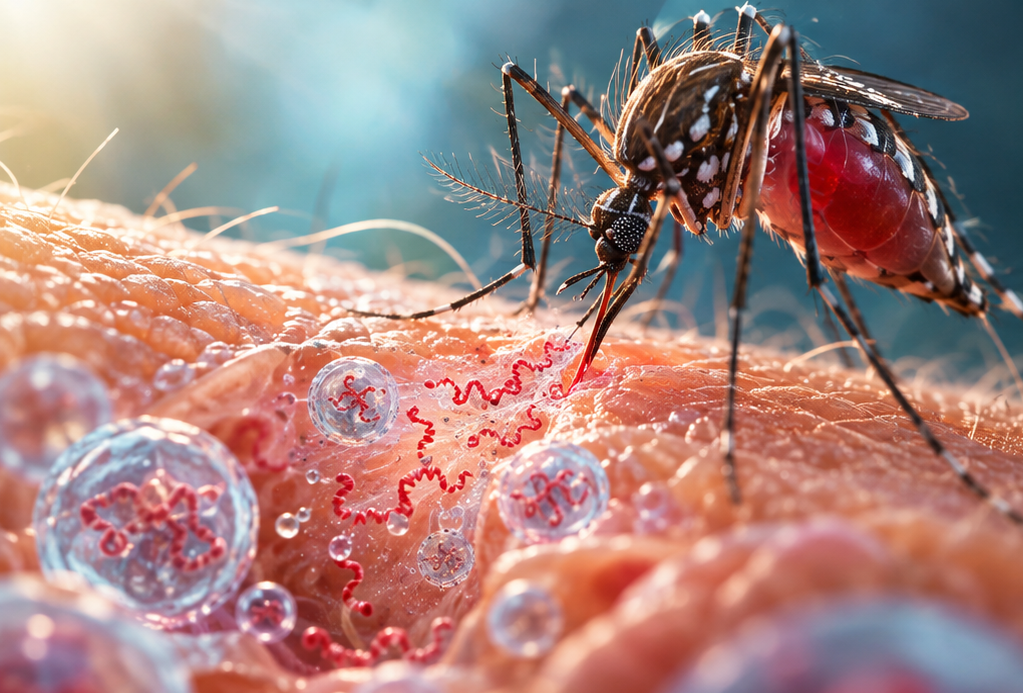
A mosquito bite lasts only a few seconds. But those few seconds can shape what happens next. As the mosquito takes its blood meal, it injects tiny droplets of saliva into the skin, a complex cocktail of molecules and microscopic particles that immediately interact with human cells. And this is precisely where the virus begins its journey.

How a mosquito bite reshapes the skin before infection takes hold:
Inside the biological mechanisms that may help flaviviruses overcome the body’s first defences
The skin is the first battlefield
The skin is not simply a physical barrier. It is an active immune organ containing cells that can recognise danger, produce antiviral signals and recruit additional immune defences.
When an infected mosquito bites, the virus encounters this protective system immediately. To establish infection, it must survive long enough to enter cells, replicate and spread. Research increasingly shows that components of mosquito saliva can help create conditions that favour this process.
FLAVIVACCINE is investigating these early interactions because they may reveal targets shared by several mosquito-borne flaviviruses.
A viral RNA that acts without making proteins
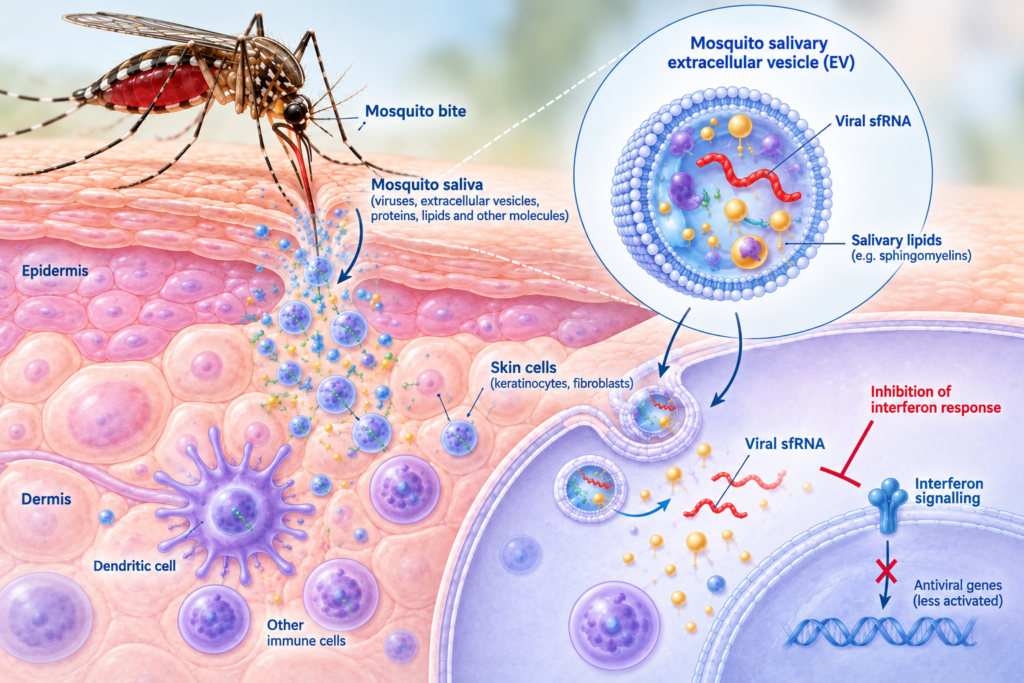
One mechanism involves subgenomic flaviviral RNA, commonly known as sfRNA. Unlike the viral RNA used to produce new virus particles, sfRNA does not encode proteins. Its importance lies instead in the way it can interfere with host defences.
Studies have found that several orthoflaviviruses can release sfRNA into mosquito saliva inside lipid-bound vesicles. When delivered to skin cells, this RNA may disrupt interferon signalling, one of the pathways used by cells to detect viral material and activate an early interferon response¹.
Interferons are warning signals. They alert infected and neighbouring cells and activate genes that make the local environment more resistant to viral replication. By weakening this response at an early stage, sfRNA may provide the virus with a brief but important advantage.
Changing the lipid environment of skin cells
Mosquito salivary extracellular vesicles can also carry lipids, including sphingomyelins. These molecules are natural components of cell membranes, but their delivery at the bite site may change the way human skin cells organise and use their own lipids.
Research published in 2025² showed that EV-derived sphingomyelins from mosquito saliva can reconfigure the lipidome of human cells. This altered environment was associated with increased viral protein production and enhanced infection by several flaviviruses.
Different mechanisms, one early window of opportunity
These mechanisms are not identical, but they act within the same critical period: the first moments and hours after the bite.
One (sfRNA) weakens the warning system. Another (lipids) modifies the material environment inside the cell. Together, they illustrate how the mosquito, the virus and the human host interact as part of a complex transmission process.
For FLAVIVACCINE, understanding this shared early window is essential. Rather than responding only after a virus has begun to spread, a vaccine strategy directed at relevant mosquito salivary components could prepare the immune system to act directly at the transmission site.
Turning biological understanding into vaccine research
Identifying a mechanism does not automatically identify a vaccine target. Researchers must determine which components are essential, whether they are sufficiently conserved and whether an immune response against them would be safe and protective.
By clarifying what happens in the skin after a mosquito bite, FLAVIVACCINE is building the scientific foundation needed to move from an innovative concept towards experimentally validated vaccine candidates.
- Serrato-Pomar, I., Medkour, H., Belleville, L. et al. Multiple orthoflaviviruses secrete sfRNA in mosquito saliva to promote transmission by inhibiting MDA5-mediated early interferon response. Nat Commun (2026). https://doi.org/10.1038/s41467-026-77288-4
- Medkour, H. et al. (2025). “Sphingomyelins in mosquito saliva reconfigure the skin cell lipidome to enhance arbovirus infection.” Cell Metabolism. https://doi.org/10.1016/j.cmet.2025.05.015
Images in this article are AI generated.