news release - October 29, 2026
The challenge and opportunity of broad flavivirus protection
Understanding viral diversity, cross-reactive immunity and antibody-dependent enhancement
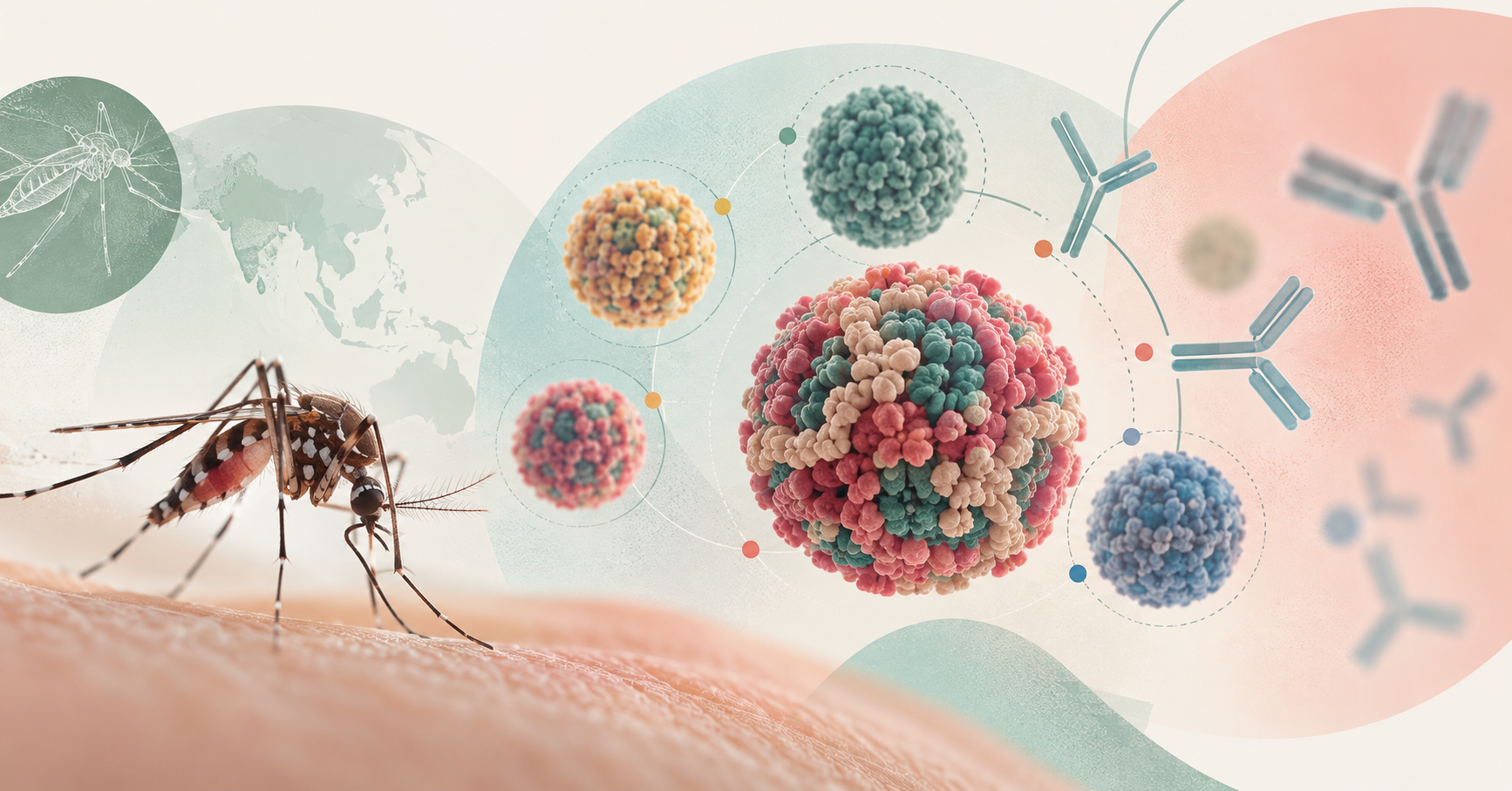
Protecting people against flaviviruses remains a complex scientific challenge. Although these viruses share important characteristics, each one can interact differently with the immune system, requiring a careful understanding of the mechanisms that drive protection. But this diversity also creates an opportunity: by identifying the common features that shape protective immunity across flaviviruses, we may be able to move beyond protection against individual viruses and towards broader-spectrum protection.
The special challenge of dengue
Dengue is caused by four closely related serotypes. Infection with one serotype generally creates long-lasting immunity against that serotype, but does not protect against the others. This means that a person can experience dengue more than once.
And here, the situation becomes more complex! In some circumstances, antibodies produced during a first infection may recognise a different dengue serotype without neutralising it effectively. The antibodies generated by a certain serotype recognize a different serotype because of similarity between serotypes. Then,these non-neutralizing antibodies may facilitate the virus entry into certain immune cells and, instead of blocking the virus, promote infection. This process is known as antibody-dependent enhancement, or ADE.
What antibody-dependent enhancement means
Antibodies normally protect the body by binding to a virus and preventing it from infecting cells. The quality and concentration of those antibodies matter.
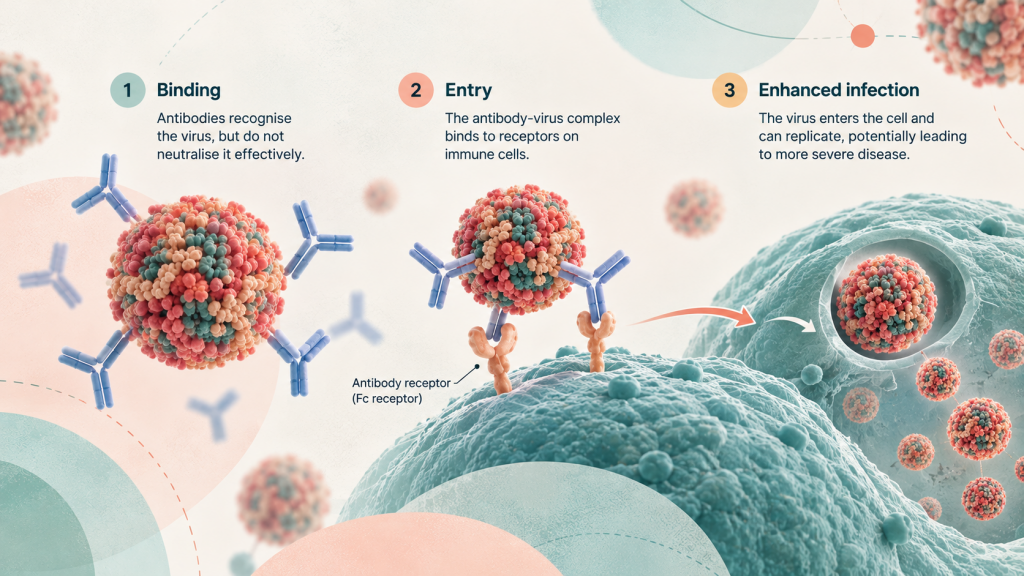
Antibody-dependent enhancement (ADE). Schematic illustration of how antibodies that recognise a virus without effectively neutralising it may facilitate infection. The antibody-virus complex can bind to Fc receptors on immune cells, allowing the virus to enter and potentially replicate. This mechanism is an important consideration in developing vaccines against related flaviviruses, particularly dengue.
When antibodies bind strongly enough and target the right viral structures, they can neutralise infection. Antibody-bound viruses are then internalized inside immune cells for destruction. When binding is incomplete or insufficiently strong, the antibody-virus complex is likewise taken up by cells carrying antibody receptors but immune cells end up with a live virus. These non-neutralizing antibodies therefore facilitate infection, aggravating clinical outcome.
ADE does not mean that every cross-reactive antibody is harmful. It describes a specific biological possibility that researchers must evaluate carefully when developing vaccines against viruses with related surface structures.
Unfortunately, the ADE phenomenon may occur across different flaviviruses, although field evaluation is lacking. For example, a previous Zika virus infection could potentially increase the severity of symptoms with following a subsequent dengueever virus infection.
Why conventional virus-targeting strategies face safety limits
Most vaccines work by training the immune system to recognise specific viral proteins and produce antibodies that can block infection. This approach has been remarkably successful for many viruses, from measles and hepatitis B to COVID-19.
However, flaviviruses present an additional challenge. In some cases, antibodies generated after a previous infection or vaccination may not fully neutralise the virus and can instead contribute to more severe symptoms through the antibody-dependent enhancement phenomenon or ADE.
This means that for flavivirus vaccines, it is not enough to generate a strong immune response—the response also needs to be carefully designed to ensure that the antibodies are protective and do not increase the risk of more severe symptoms.
Changing the target of vaccination
FLAVIVACCINE is exploring whether part of this challenge can be addressed by changing the target.
Instead of relying exclusively on antigens from each individual virus, the project focuses on components within mosquito saliva that participate in the shared transmission process.
The mosquito bite is a common starting point for several flavivirus infections. By preparing the immune system to recognise selected mosquito-derived factors in saliva, the project aims to create an early protective response that is less dependent on the identity or serotype of the virus.
A new route, grounded in an existing need
The FLAVIVACCINE concept does not seek to replace every existing vaccine approach. It responds to a clear limitation: the difficulty of achieving balanced protection across multiple related viruses while avoiding immune responses that may be incomplete or counterproductive.
By targeting a salivary factor that increase transmission for multiple flaviviruses, the project is testing a different way to think about broad protection.
References
Authoritative background on the four dengue serotypes and immunity following infection.
- https://pubmed.ncbi.nlm.nih.gov/40480856/
- https://pubmed.ncbi.nlm.nih.gov/32367055/
- https://www.science.org/doi/10.1126/scitranslmed.adi1734
Peer-reviewed literature on antibody-dependent enhancement in dengue.
- https://www.frontiersin.org/journals/immunology/articles/10.3389/fimmu.2020.00334/full
- 10.1093/cid/ciab282
The images in this article are AI generated.