news release - August 4, 2026
Tiny messengers, major impact: Extracellular vesicles in mosquito-borne flavivirus transmission
How microscopic particles in mosquito saliva may shape flavivirus transmission and open new paths for vaccine innovation
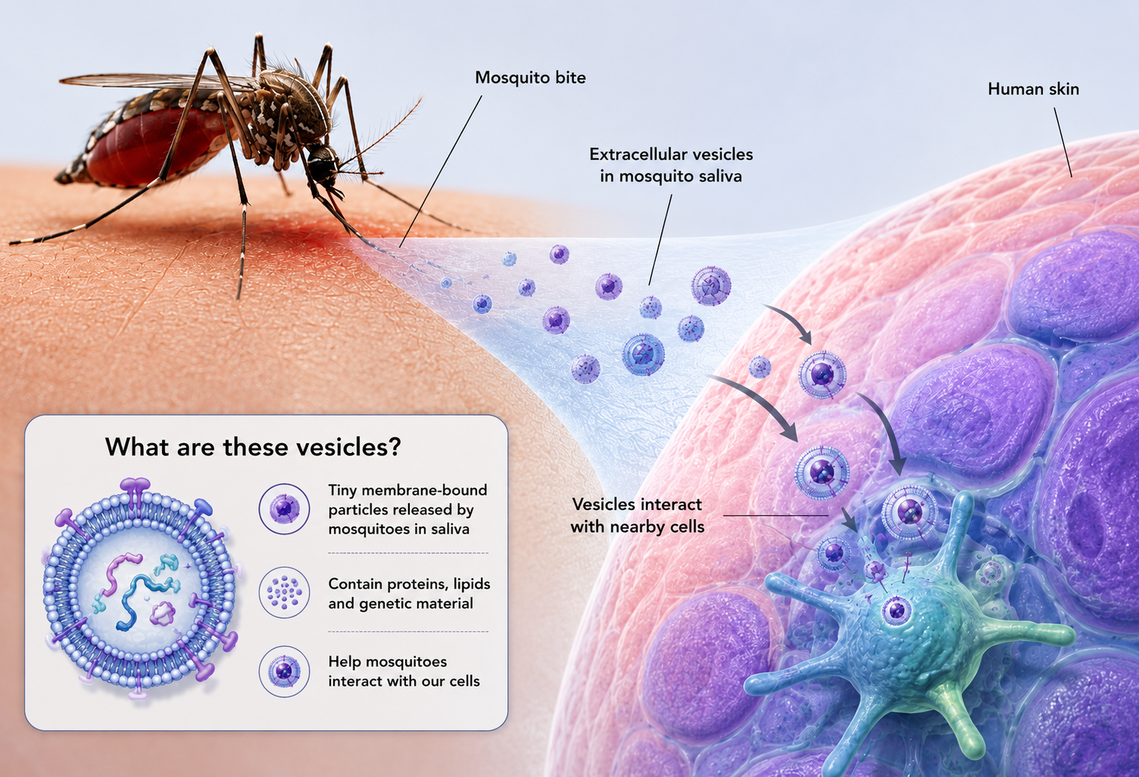
When a mosquito bites, it does more than create an irritating mark on the skin. It introduces saliva containing a complex mixture of biological substances that help the mosquito feed, interact with human cells and influence the earliest stages of virus infection.
Among these substances are tiny membrane-bound particles known as extracellular vesicles, or EVs. Although they are invisible to the naked eye, these microscopic messengers may play an important role in helping mosquito-borne viruses establish an infection.
Understanding how they work is opening a new direction for flavivirus research and could help FLAVIVACCINE identify targets for broader protection against diseases such as dengue, Zika, yellow fever and West Nile.
What are extracellular vesicles?
Cells naturally release extracellular vesicles as a way of transporting biological material. Surrounded by a lipid membrane, EVs can carry proteins, fats and different forms of genetic material from one cell or biological environment to another.
They can therefore be understood as small delivery packages that allow cells to communicate and modify the behaviour of other cells.
Mosquito cells release these vesicles too. Research published in 2025 by the Pompon’s team confirmed that mosquito-derived EVs vary considerably in size, with many measuring less than 100 nanometres, and showed that smaller vesicles are present in mosquito saliva [1]. The study also assessed different methods for isolating and characterising these particles, providing an important basis for future research into their biological functions.
Their presence in saliva is particularly significant because saliva is deposited directly into the skin when a mosquito feeds.
More than a simple carrier
Extracellular vesicles are not passive particles. The materials they transport can influence the cells that receive them.
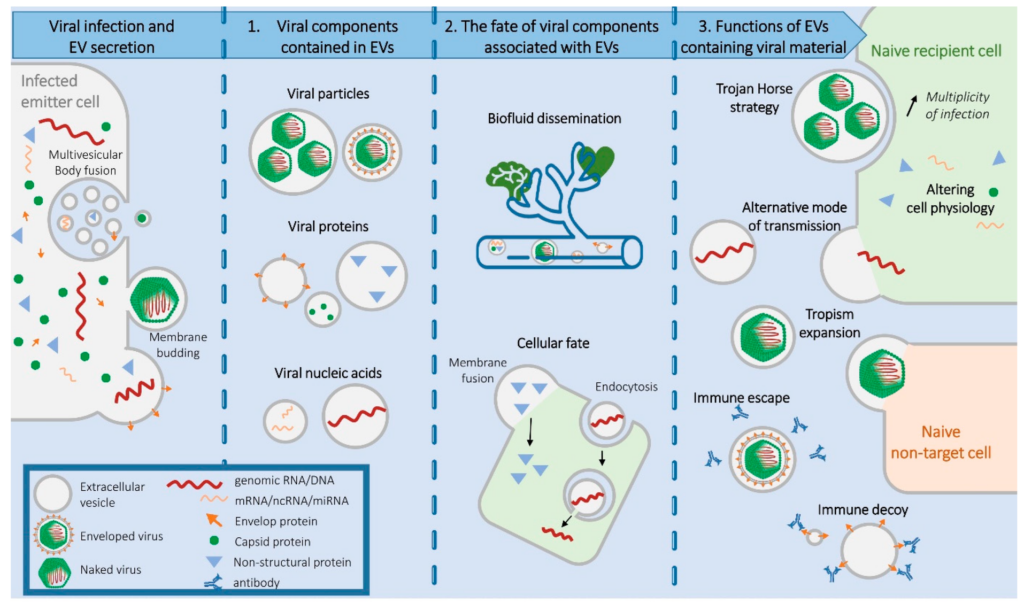
Overview of the associations between Extracellular Vesicles (EVs) and viral components. (https://doi.org/10.3390/v15122333)
In the context of flavivirus transmission, research suggests that mosquito salivary EVs may carry components that make the environment at the bite site more favourable to infection.
One example is subgenomic flaviviral RNA, commonly known as sfRNA. This viral RNA does not produce viral proteins, but it can interfere with the host’s early immune response. Research on dengue virus found that sfRNA present in mosquito salivary vesicles can be delivered to cells at the bite site, where it inhibits antiviral defences and enhances transmission [2].
More recent research suggests that this mechanism may not be limited to dengue. A 2025 preprint, recently approved and that will be published soon, reported that several orthoflaviviruses secrete sfRNA into mosquito saliva within lipid vesicles and use it to suppress an important early interferon response. This points to a potentially shared transmission mechanism across multiple viruses.
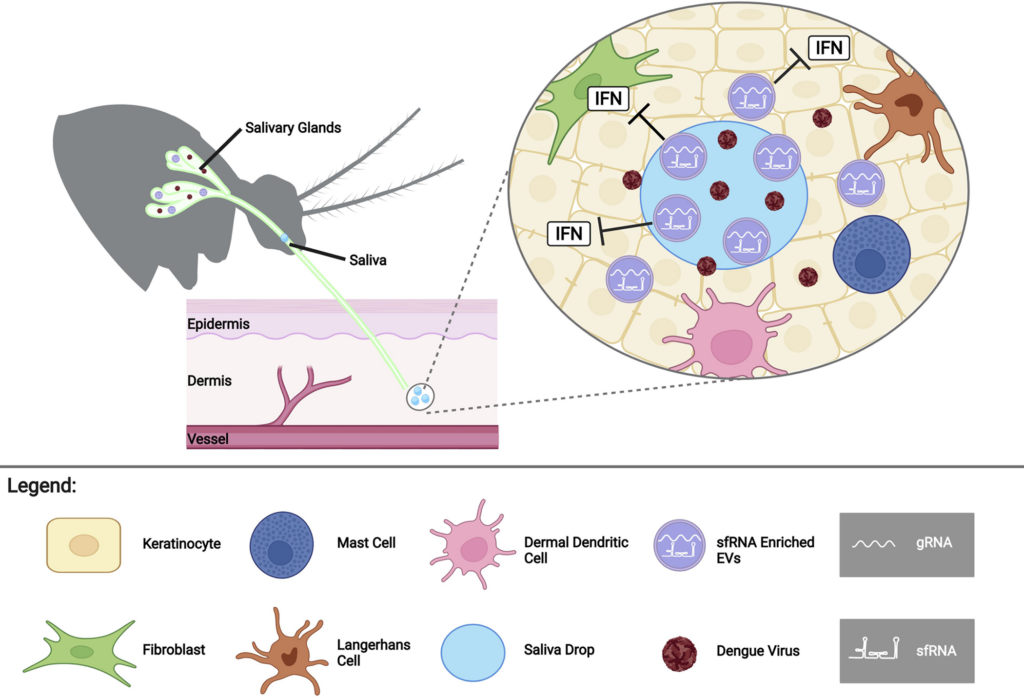
Model: sfRNA in salivary vesicles is transported into cells to enhance infection at the biting site. sfRNA packaged inside extracellular vesicles in infectious mosquito saliva is transferred to human skin cells during biting. sfRNA inhibits the antiviral innate immune response (interferon (IFN) system) to enhance skin cell virus infection. (https://doi.org/10.1371/journal.ppat.1011224.g006)
EVs can also transport lipids that influence infection. A study published in Cell Metabolism found that sphingomyelins carried by mosquito salivary EVs can alter the lipid composition of human skin cells [3]. This change increases viral protein levels and enhances infection by several flaviviruses.
Together, these findings show that a mosquito bite is not simply a route through which a virus enters the body. It creates a biological environment that can actively support transmission.
Why are mosquito salivary EVs a promising target?
Most vaccines are developed to recognise a particular virus or one of its components. This approach can be highly effective, but it also presents challenges when several related viruses circulate or when viruses evolve.
FLAVIVACCINE is exploring a different strategy. Rather than focusing exclusively on one virus, the project is investigating mosquito-derived factors involved in the shared process of flavivirus transmission.
Mosquito salivary EVs are particularly interesting because they act at a very early stage, before the virus has had time to spread extensively through the body. They may also support the transmission of more than one flavivirus through common mechanisms.
Targeting EVs could therefore help the immune system respond rapidly at the site of the bite and make the local environment less favourable to infection.
From discovery to vaccine development
The growing scientific understanding of mosquito salivary EVs provides FLAVIVACCINE with an innovative route for developing a pan-flavivirus vaccine candidate.
The project is building on evidence that mosquito saliva actively shapes virus transmission and that extracellular vesicles are among the factors involved in this process. By studying their composition and identifying the components that promote infection, researchers can begin to select and test potential vaccine antigens.
The next steps will require careful laboratory investigation, including the production and evaluation of EV targets, the measurement of immune responses, and the assessment of their protective potential in appropriate experimental models. Building on a strong scientific foundation and encouraging preliminary evidence, the project team is confident that this approach has clear potential to deliver impactful results.
While this work is still progressing, the underlying concept is clear: preventing flavivirus infection may require us to look not only at the virus, but also at the microscopic messengers delivered with the mosquito bite.
By revealing what these hidden particles carry and how they interact with the skin, FLAVIVACCINE is helping turn a previously overlooked part of mosquito biology into a promising opportunity for vaccine innovation.
- Rey-Cadilhac, F. et al. (2025). “Characterization of size distribution and markers for mosquito extracellular vesicles.” Frontiers in Cell and Developmental Biology, 13, 1497795.
DOI: 10.3389/fcell.2025.1497795
This is the reference supporting the description of mosquito-derived extracellular vesicles, their size distribution, their molecular markers and the presence of smaller EVs in mosquito saliva. - Yeh, S.-C. et al. (2023). “The anti-immune dengue subgenomic flaviviral RNA is present in vesicles in mosquito saliva and is associated with increased infectivity.” PLOS Pathogens, 19(3), e1011224.
DOI: 10.1371/journal.ppat.1011224
This study supports the section explaining that dengue sfRNA can be present in salivary vesicles, inhibit early antiviral responses and enhance infection at the mosquito-bite site. - Medkour, H. et al. (2025). “Sphingomyelins in mosquito saliva reconfigure the skin cell lipidome to enhance arbovirus infection.” Cell Metabolism.
This reference supports the section on sphingomyelins carried by mosquito salivary EVs and their ability to alter the lipid environment of human cells in ways that can favour flavivirus infection. - Serrato-Pomar, I. et al. (2025). “Multiple orthoflaviviruses secrete sfRNA in mosquito saliva to promote transmission by inhibiting MDA5-mediated early interferon response.” bioRxiv preprint.
DOI: 10.1101/2025.01.21.634113
This is the preprint mentioned in relation to the possibility that sfRNA secretion in mosquito saliva represents a shared mechanism across several orthoflaviviruses.
Featured image in this article is AI generated.